
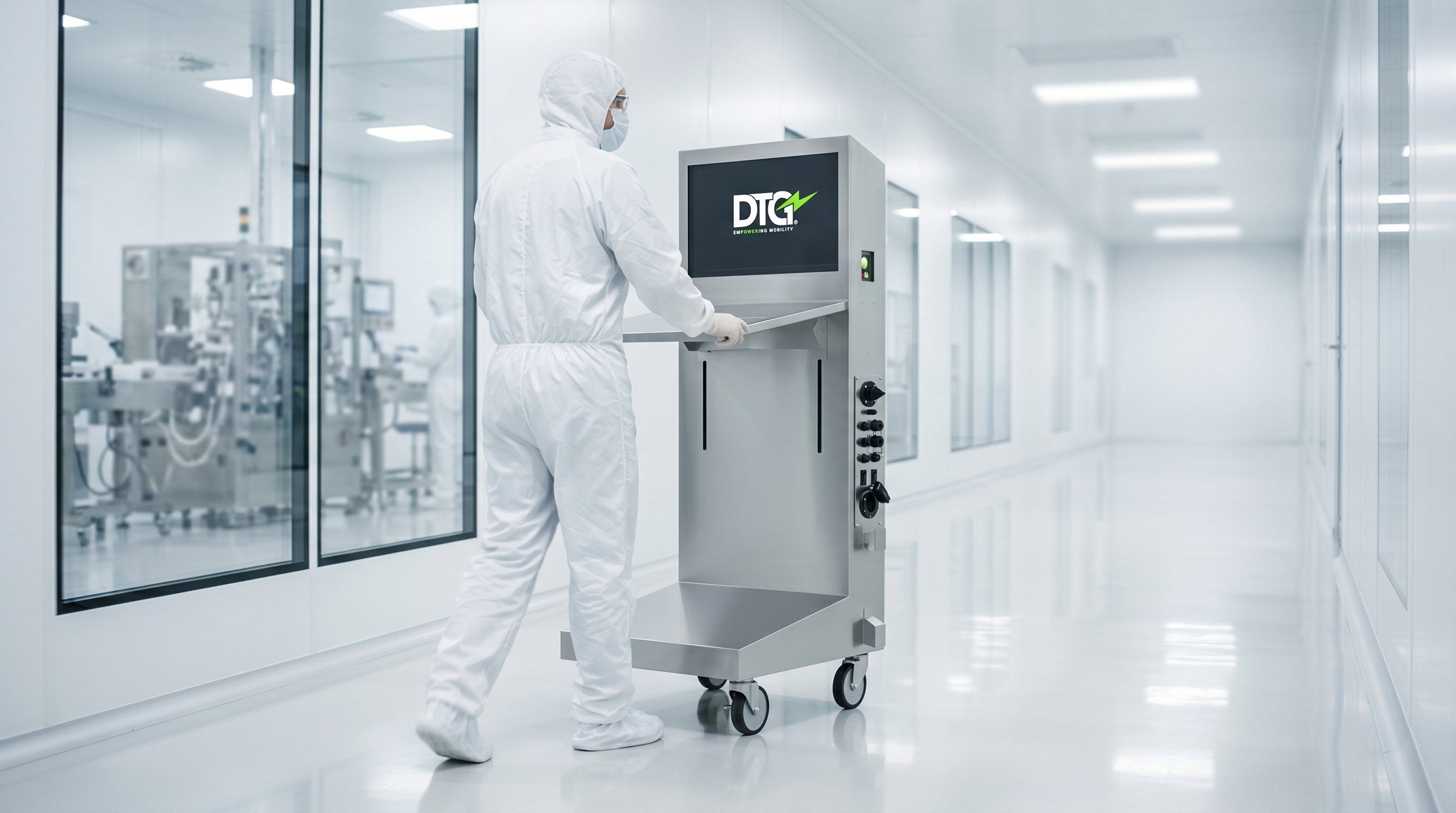
What is a cleanroom mobile workstation?
A cleanroom mobile workstation is a powered cart built for controlled manufacturing environments. It holds a display and compute device at the point of task so operators don't walk back to a fixed terminal every time they need to sign off on a batch record or pull up an SOP.
The concept is simple. Getting it to work inside a cleanroom is not. The cart needs materials that survive aggressive cleaning agents. The battery has to clear EHS review. Runtime has to last a full shift under real conditions, not best-case specs. And whatever you put on the cart, your IT team has to be willing to support it.
DTG's Cleanroom PowerStation was built around these constraints: swappable LFP batteries for safe mobile power, support for your choice of compute and display hardware, and cleanroom-grade 316 stainless steel construction. It typically runs $15–20K for Class A–B environments, which is roughly half what most biopharma teams have been quoting from other vendors.
Quick answers
- What is a cleanroom mobile workstation? A mobile cart designed for controlled environments that provides a stable work surface and compliant power for computing at the point of task.
- Why do biopharma teams use them? Operators in regulated manufacturing spend more time walking to and from fixed terminals than most people realize. Mobile workstations cut that motion waste. They also reduce the risk of deviations caused by mid-task interruptions. The common scenario: someone leaves the line to document a step, gets pulled into something else, comes back ten minutes later, and now the batch record has a gap.
Where mobile workstations earn their keep on the floor
Not every cleanroom workflow needs a mobile workstation. But several common ones get measurably worse without point-of-use computing.
MES and EBR signoffs are the obvious one. Batch record entries happen where the work happens, not ten minutes later at a terminal across the room.
SOP and controlled document access matters too, especially for operators in full PPE who shouldn't need to strip gloves to thumb through a binder or walk to a fixed screen.
QA and line clearance checklists go faster with fewer transcription errors when the checklist is at the line.
Environmental monitoring and sampling benefits from real-time data entry at the sampling point instead of handwritten notes transferred later.
Maintenance and calibration work is easier when you can pull up equipment history and procedures on the spot instead of carrying a printed packet.
Then there's emergency response, what some sites call "crash cart" mode. An IT or engineering team rolls a powered workstation to wherever the problem is, whether that's troubleshooting a deviation in progress or supporting an unplanned equipment intervention.
How to shortlist vendors: a buying checklist
These are the questions that come up in every purchase committee we've seen evaluate cleanroom mobile workstations:
- [ ] Cleanable surfaces. Do the materials and finishes tolerate your cleaning agents and frequency? This varies by ISO class.
- [ ] Battery safety. Will EHS approve the chemistry? What's the thermal stability profile? Can you provide safety documentation upfront?
- [ ] True runtime. Not the best-case number. Runtime under your expected load, display configuration, and duty cycle. Ask for verified data.
- [ ] IT flexibility. Can you mount your preferred display and compute hardware, or are you locked into the vendor's configuration?
- [ ] Serviceability. Can batteries be swapped in the field? Can components be replaced without a factory return?
- [ ] Total cost of ownership. Purchase price matters, but so do uptime, support responsiveness, and how many years you get out of the unit. DTG's PowerStation typically runs $15–20K for Class A–B, compared to $25–30K for most competitors.
Battery safety: the question that decides timelines
Battery approval is where cleanroom mobile workstation projects stall. EHS teams want to understand chemistry, thermal behavior, charging safety, and what happens in a failure scenario. Rightly so.
A cleanroom isn't a warehouse. A thermal event in a controlled environment doesn't just damage equipment. It can contaminate product, shut down production, and trigger a remediation process that lasts weeks. EHS teams evaluate battery risk with that in mind.
Most biopharma teams land on LFP (Lithium Iron Phosphate) for this reason. It has a strong thermal stability profile compared to NMC or NCA cells. The trade-off is lower energy density, but in a cart that sits on a floor, you're optimizing for safety and predictability, not weight savings. LFP is the easiest chemistry to defend in an EHS review.
Swappable batteries add another layer. If a battery can be hot-swapped, you get uninterrupted runtime when a shift runs long, plus easier maintenance when a cell eventually degrades. DTG's PowerStation uses swappable LFP packs that support 8–12 hours of true runtime per charge. A backup pack means an operator never hits a dead cart mid-batch.
IT-agnostic design: why it matters on the cleanroom floor
Most powered cleanroom carts ship with a fixed hardware configuration. The vendor picks the display, the compute device, and the mounting setup. If your IT team runs a different standard, or if that standard changes in two years, you're stuck buying new carts or bolting on workarounds.
This is a bigger deal than it sounds. Biopharma IT environments are not uniform. One site might run thin clients connected to a Citrix back end. Another might use full PCs with locally installed MES software. A third might have standardized on ruggedized tablets that they already own and support. The cart vendor shouldn't be the one making that call.
DTG's Cleanroom PowerStation is built to be IT-agnostic. It provides safe mobile power and a cleanroom-grade work surface, but the compute and display hardware is yours to choose. Mount the monitors your IT team already supports. Use the thin client or PC that matches your existing image. Swap in a tablet if that's what works for your workflow. When IT standards change down the road, you change the hardware on the cart, not the cart itself.
The practical effect: IT doesn't have to maintain a separate hardware stack just for the cleanroom floor. They support the same devices they support everywhere else, which means fewer tickets, faster troubleshooting, and no vendor lock-in if the technology landscape shifts.
For sites that have already invested in tablets or other compute hardware, this also means the PowerStation doesn't force you to throw away what you already own. It gives that hardware a stable, powered, cleanroom-compliant home at the point of task.
ROI: a rough model you can actually use
The core question is straightforward: how much time do your operators spend walking to and from fixed terminals?
The formula:
Minutes saved per operator per shift × loaded labor rate × shifts per day × operating days per year
Industry benchmarks put motion waste at 15–30 minutes per operator per shift in facilities that rely on fixed terminals. For a site running two shifts with 10 operators per shift, even 15 minutes saved per person per shift adds up to over $50K annually at typical biopharma labor rates. Larger facilities can see $100K–150K in annual waste.
At $15–20K per unit, payback typically lands in the 12–18 month range. Often faster, once you account for the things that are harder to put a number on: fewer deviations from interrupted workflows, reduced ergonomic injury risk, less time spent on deviation investigations.
Comparison: fixed stations vs. tablets vs. powered carts
Frequently asked questions
What is a cleanroom mobile workstation?
A purpose-built powered cart that provides a stable work surface and compliant mobile power for point-of-use computing in regulated cleanroom environments, primarily biopharma manufacturing.
Why do biopharma manufacturers use mobile workstations on the cleanroom floor?
To keep MES/EBR signoffs, SOP access, and QA checks at the point of task instead of sending operators back and forth to fixed terminals. Less motion waste, fewer deviations from interrupted workflows, better ergonomics.
What cleanroom ISO classes are compatible with mobile workstations?
Compatibility depends on materials, surface finishes, and resistance to your cleaning agents. ISO 8 and lower (less stringent) environments can use any cleanroom mobile workstation. More stringent classifications like ISO 1-7 require tighter material specs. DTG offers 316-grade stainless steel construction for Class A–B environments and alternative surface materials for Class C and lower.
What battery chemistry works best in a biopharma cleanroom?
LFP (Lithium Iron Phosphate) is the most commonly approved chemistry for regulated environments. Thermal stability is the main reason. It clears EHS review more easily than higher-energy-density chemistries like NMC. The trade-off is lower energy density, but that doesn't matter much in a floor cart.
How long does the battery last on a shift?
Depends on load, display configuration, and duty cycle. DTG's PowerStation delivers 8–12 hours of true runtime. Swappable battery design means you can hot-swap a fresh pack if a shift runs long. No downtime, no dead cart mid-batch.
Can a cleanroom mobile workstation work with our existing IT setup?
If the workstation supports your choice of compute and display hardware rather than locking you into a proprietary configuration, yes. DTG's PowerStation is IT-agnostic, so you mount whatever hardware and software your IT team already manages. No separate hardware stack for the cleanroom floor.
What are the main EHS approval bottlenecks?
Battery chemistry and thermal behavior. EHS teams evaluate thermal stability, protection circuitry, charging behavior, and failure-mode documentation. LFP clears this process more easily than other lithium chemistries, but every site runs its own review.
Why do swappable batteries matter?
Runtime continuity: if a shift runs long or a battery is low, you swap in a fresh one without pulling the workstation offline. Lifecycle maintenance: when a battery cell degrades over time, you replace the pack instead of sending the whole cart back to the manufacturer.
How do mobile workstations compare to tablets and fixed terminals?
Fixed terminals are stable but force operators off the line. Tablets are portable but come with runtime, security, and PPE usability problems. Powered carts solve both, but most options on the market run $25–30K+ and lock you into one vendor's hardware. DTG's approach is IT-agnostic flexibility with safe LFP power at $15–20K for Class A–B.
Want to Learn More?
Whether you need a quote, want to see a demo, or just have questions, we'd love to hear from you.
Get custom pricing for any of our products. Our team will respond within 24 hours.
Request a free 30 minute virtual demo of any of our products.
Speak with our team directly Monday through Friday from 9AM to 5PM EST.