
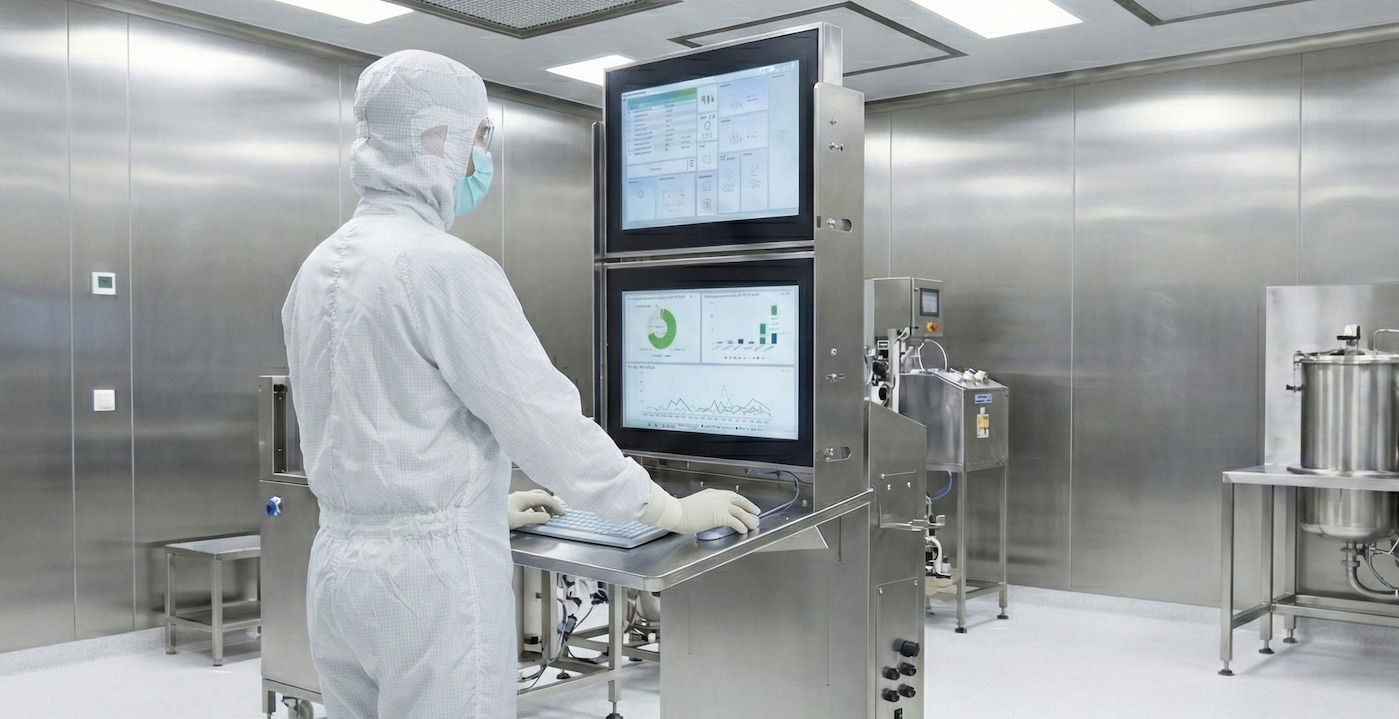
What does it mean to validate a mobile cleanroom workstation?
Validating a mobile cleanroom workstation means qualifying it through documented IQ, OQ, and PQ so your quality team can prove it was installed correctly, operates as intended, and performs reproducibly in your GMP process. In practice you are not validating the cart itself. You are qualifying a defined, repeatable configuration of hardware, power, and software against your facility's existing validation procedures.
That distinction is the whole game. Treat the workstation as a brand new system that needs validation from scratch and the project balloons. Treat it as equipment that folds into the qualification path you already run for computerized systems, and it becomes routine.
Quick answers
- Do you have to validate a mobile workstation? If it touches GMP records, runs your MES, or supports batch execution, yes. The computerized system it carries falls under 21 CFR Part 11 and EU GMP Annex 11, both of which require validation of systems used for regulated electronic records.
- What does the workstation actually need from the vendor? A documented, repeatable configuration and qualification support documentation: design specs, materials certificates, and the information your IQ and OQ protocols call for. A workstation that ships in a known, stable build is far easier to qualify than one assembled ad hoc.
- Is this a separate validation project? It should not be. Most teams fold the workstation into the qualification package they already use for the MES or quality system running on it, rather than standing up a parallel effort.
Why validation is where these projects stall
Battery safety is the bottleneck that EHS owns. Validation is the bottleneck that quality owns. We see both stop mobile workstation projects, and validation is the one buyers underestimate.
The fear is reasonable. A workstation moves to the point of task within the suite, runs on batteries, and may carry different compute hardware than the fixed terminals quality already qualified. That raises a fair question: how do you prove a piece of equipment that moves behaves the same way every time, across its service life?
The answer is the same as it is for any GMP computerized system. You define the configuration, you document it, and you qualify it against intended use. The framework does not change. There are just a few extra specifics to verify, which we cover below.
Qualification vs. validation, and where the workstation fits
The terms get used interchangeably, but EU GMP Annex 15 draws a clean line. Qualification demonstrates that facilities, utilities, and equipment are properly designed, installed, operated, and perform as intended. Validation is the documented proof that a process consistently produces output meeting specifications. Equipment gets qualified. Processes get validated.
A mobile cleanroom workstation is equipment. So it moves through the qualification stages Annex 15 lays out:
- Design Qualification (DQ): documented verification that the proposed design suits the intended purpose. For a workstation this is where you confirm materials, ISO class compatibility, power approach, and compute requirements before anything is built or bought.
- Installation Qualification (IQ): documented verification that the equipment, as installed, complies with the approved design.
- Operational Qualification (OQ): documented verification that the equipment performs as intended across its operating range.
- Performance Qualification (PQ): documented verification that the equipment performs effectively and reproducibly under real process conditions.
Annex 15 frames all of this as a lifecycle, not a one-time event. Qualification starts at design and continues through ongoing monitoring and periodic review. That lifecycle view matters for a workstation, because the compute hardware on it will eventually change, and your documentation needs to keep pace.
The risk-based reality: you scale the effort to the risk
You do not have to test everything to the same depth. Both the FDA and ISPE moved the industry toward risk-based qualification years ago, and that is the single biggest lever for keeping a workstation project small.
GAMP 5, the ISPE guide that most pharma teams use as their CSV framework, says validation of computerized systems should focus on intended use and be scaled to the risks to patient safety, product quality, and data integrity. The second edition, published in 2022, leans even harder into that principle and folds in Computer Software Assurance.
The FDA's Computer Software Assurance guidance points the same direction. It describes a risk-based approach where lower-risk software functions need minimal assurance activity, and effort concentrates on the functions that actually affect product and data.
What this means for your workstation: the power system, mounting, and cleanroom-grade construction are equipment you qualify through IQ and OQ. The compute device and software that run your MES, QMS, monitoring systems, or EBR follow your existing computer system validation path. You do not re-validate Windows or your MES because it now sits on a cart. You qualify the workstation as the equipment that hosts an already-qualified system, and you verify the specifics the workstation introduces.
What to verify at each stage
Installation Qualification (IQ)
IQ confirms the workstation as installed matches the approved design. For a mobile cleanroom workstation, your protocol typically verifies:
- Construction materials and surface finishes match spec (for example, 316 stainless steel for ISO 1-7 environments) and tolerate your cleaning agents
- The unit's identification, serial number, and configuration are recorded and match the purchase specification
- Battery chemistry, capacity, and charging components match the approved design, with vendor safety documentation on file
- The compute device, display, and peripherals match your IT standard and approved image
- Required vendor documentation is present: design specs, materials certificates, and safety data
Operational Qualification (OQ)
OQ confirms the workstation performs across its operating range. Common test points:
- Battery runtime under expected load, display configuration, and duty cycle, verified against the vendor's stated runtime rather than a best-case number, and confirmed to cover your longest expected shift
- Charging behavior and any thermal protections function as documented
- The compute device boots to the approved image and connects to the network and MES from each intended location
- Display readability and touch or input performance in PPE, which is an OQ concern most teams forget until an operator in three glove layers cannot register a tap
Performance Qualification (PQ)
PQ confirms the workstation does its job reproducibly under real process conditions:
- Operators complete representative GMP workflows (batch record entries, SOP lookups, line clearance, QA checks) from the workstation at the points within the suite where it will be used
- Performance holds reproducibly across shifts and operators, not just one test run
- The audit trail captures entries accurately and contemporaneously through the workstation, the way an inspector expects to see it
- Running a full shift on the workstation does not interrupt documentation or open gaps in the audit trail
The data integrity layer hardware actually affects
Most data integrity content focuses on software, and rightly so. But a few hardware decisions on the workstation feed directly into your 21 CFR Part 11 and Annex 11 posture, so they belong in your qualification thinking.
21 CFR Part 11 requires validation of systems used for regulated electronic records, secure time-stamped audit trails, and authority checks that limit who can access the system and sign records. The system on your workstation handles those controls, but the workstation has to support them without workarounds. If power dies mid-entry and forces operators to a backup paper process, you have introduced a data integrity gap that traces straight back to runtime. If the workstation cannot run your standard security stack and authentication, you have created an access control problem.
This is the practical case for full-shift battery runtime and IT-agnostic compute. They do real work for compliance. They keep records contemporaneous and keep the workstation inside your validated environment instead of forcing operators around it. The ALCOA+ principles inspectors apply, that data be attributable, legible, contemporaneous, original, and accurate, are easier to defend when the hardware never forces operators off the system.
What makes a workstation "validation ready"
Validation ready is a real, checkable property, not marketing language. A workstation is validation ready when:
- It ships in a documented, repeatable configuration, so the unit you qualify is the unit you receive, every time
- It has a defined operating envelope (runtime, load, environmental limits) you can write OQ tests against
- The vendor provides qualification support documentation that maps to IQ and OQ expectations: design specs, materials certificates, battery safety data, and configuration records
- It is IT-agnostic, so the compute and software follow your existing CSV path rather than locking you into a proprietary box you have to qualify from scratch
DTG's Cleanroom PowerStation is built to clear this bar. It ships in a repeatable configuration with 316 stainless steel construction for ISO 1-7 environments and IT-agnostic compute, so your team mounts the hardware and runs the OS image, security stack, and MES it already qualifies elsewhere. Its power system uses LFP (lithium iron phosphate), the most thermally stable mainstream lithium chemistry, with a far higher thermal runaway threshold than NMC or NCA cells. That gives EHS and quality one less failure mode to document during the safety review. DTG also provides IQ, OQ, and PQ documentation support to map the workstation to your protocols, so it becomes the equipment that hosts your validated system rather than a separate validation headache.
How to keep this from becoming a separate project
The teams that move fast do four things: lock materials, ISO compatibility, power, and compute requirements at DQ before purchase, so IQ has an approved design to verify against; fold the compute and software into the CSV package they already run for that MES or quality system instead of re-validating an application that only changed location; scale testing to risk using GAMP 5 and CSA thinking; and get vendor documentation in hand before the unit arrives so IQ is not waiting on paperwork. Done this way, qualifying the workstation is routine equipment work, not a quarter-long project.
Frequently asked questions
What does it mean to validate a mobile cleanroom workstation?
It means qualifying the workstation through documented IQ, OQ, and PQ and folding the compute and software it carries into your existing computer system validation. You prove the unit was installed to its approved design, operates across its range, and performs reproducibly in your GMP process.
Do mobile workstations need IQ, OQ, and PQ?
If the workstation supports GMP records or runs your MES, yes. IQ verifies it was installed per the approved design, OQ verifies it performs across its operating range, and PQ verifies it performs reproducibly under real process conditions across shifts and operators.
Is a mobile workstation a separate validation project?
It should not be. Most pharma teams qualify the workstation as equipment and fold the compute and software into the qualification package they already use for the system running on it, rather than running a parallel validation effort.
What makes a cleanroom workstation validation ready?
A documented, repeatable configuration, a defined operating envelope you can write tests against, vendor documentation that maps to IQ and OQ, and IT-agnostic compute so the software follows your existing CSV path. DTG's Cleanroom PowerStation is built around these traits.
How does 21 CFR Part 11 apply to a mobile workstation?
Part 11 requires validation of systems used for regulated electronic records, secure time-stamped audit trails, and authority checks. The system on the workstation handles those controls, but the workstation must support them without workarounds, which is why full-shift runtime and a standard security stack matter.
How do I qualify battery runtime for a cleanroom workstation?
Test runtime during OQ under your expected load, display configuration, and duty cycle, and verify it against the vendor's stated runtime rather than a best-case figure. Confirm it covers your longest expected shift under real operating conditions.
Why does battery chemistry matter for validation and EHS sign-off?
LFP (lithium iron phosphate) is the most thermally stable mainstream lithium chemistry, with a much higher thermal runaway threshold than NMC or NCA. That speeds up the EHS safety review and gives quality one less failure mode to document during qualification. DTG's Cleanroom PowerStation uses LFP for this reason.
What regulations and guidance govern this?
EU GMP Annex 15 defines the qualification stages (DQ, IQ, OQ, PQ). 21 CFR Part 11 and EU GMP Annex 11 govern electronic records and computerized systems. ISPE's GAMP 5 and the FDA's Computer Software Assurance guidance provide the risk-based framework for scaling validation effort to actual risk.
Want to learn more?
For the full breakdown of the workstation, power, and configuration requirements behind point-of-use computing in regulated environments, see the pillar guide: Cleanroom Mobile Workstations for Biopharma Manufacturing. To see how a validated workstation cuts waste and deviations on the floor, read Point-of-Use Computing in Pharma.
Ready to spec a validation-ready unit? Request a quote or schedule a demo of the Cleanroom PowerStation.
Want to Learn More?
Whether you need a quote, want to see a demo, or just have questions, we'd love to hear from you.
Get custom pricing for any of our products. Our team will respond within 24 hours.
Request a free 30 minute virtual demo of any of our products.
Speak with our team directly Monday through Friday from 9AM to 5PM EST.